
Wellness Reset
Summer can bring a welcome break from school, but less structure can make it harder to maintain routines and skills. Explore practical ways to build planning, cooking, social skills, and daily routines into your child’s summer while preparing for a smoother return to school.
As summer nears to an end, now is a good opportunity to reset for the upcoming school year or change of seasons. Oftentimes, the fall brings new routines, a busier schedule, and new experiences. To support a smooth transition, Aspire Services has put together 5 of our favourite ways to reset and prepare for this new, busier season.
Evening Wind Down
Create a relaxing, low pressure evening routine to allow your body and brain time to process the events of the day and prepare for the next day. For example, this might look like scheduling time to watch your favourite show while enjoying a warm drink. Or doing an act of self care while snacking on your favourite chips. To take this a step further, you could pair it with an activity to prepare for the next day. For example, plan your outfit or pack your lunch, then enjoy your relaxing evening routine. The goal with this is to be mindful and intentional, and allow yourself time to reset before going to bed and starting the next day.
Mid Year Goal Check In
Now that we are past the half way mark for the year, it’s a great time to pause and look back on any goals you've set for yourself. A check in can help keep you accountable and help you identify if you are on track or behind on goals.
Sunday Reset
Similar to an evening routine, an intentional Sunday reset can help you feel prepared and ease anxiety for the rest of the week. A Sunday reset could include multiple tasks such as washing laundry from the previous week, catching up on dishes, meal prepping lunches for the week, and tidying your space to have a fresh start on Monday morning. Even picking 1-2 of these tasks can help with the transition into the new week.
Coping Tools
As fall often brings new routines, new places, and new people, it’s helpful to check in with yourself and refresh on what tools help you feel regulated when feeling anxious, upset, or overwhelmed. At Aspire, we encourage clients to build a “coping tool box”. This is a collection of items and prompts that you have identified as helpful. We recommend keeping these items together in one place such as in a ziploc bag or cosmetic bag so that the items can be moved easily from home, school, work, or the community. A coping toolbox might include fidgets, gum/mints, sour candy, breathing visuals, headphones, and whatever else helps you feel calm and safe. A quick tip, practice identifying what it feels like in moments before overwhelm and potential triggers so that you know when to implement your coping strategies.
Sleep Reset
One of the most important pieces of your wellness is sleep. An inconsistent sleep schedule or lack of sleep can greatly affect your physical, emotional, and mental health. Now is a good time to assess your sleep schedule to see if you are getting enough hours of sleep and if your current sleep schedule compliments your fall routine. For example, going to sleep at 2am and waking up at 11am will not be effective when starting school at 8am in a few weeks. If you think that your sleep schedule needs to be adjusted, try going to bed/waking up 30 minutes earlier over the next few weeks until you are going to bed and waking up at an appropriate time for your upcoming fall schedule.

Summertime Skills
Summer can bring a welcome break from school, but less structure can make it harder to maintain routines and skills. Explore practical ways to build planning, cooking, social skills, and daily routines into your child’s summer while preparing for a smoother return to school.
Now that summer is in full swing and school schedules are in the past, you’ve likely noticed a lack of routine and consistency throughout you or your child's day. As great as summer is, the lack of routine can sometimes create anxiety or a set back in skills worked on throughout the rest of the year. To support a smooth transition back to school and continuous growth in skills, consider building these activities into your summer routine.
Schedule & Planning
To continue growing skills, aim to implement activities that require planning and time management. One way this can be practiced is by using a calendar or planner as a visual. Have a prepared list of appointments, tasks, responsibilities, or plans for the week and ask your child to add these to the calendar. Start with pre-scheduled items such as appointments and provide guidance to schedule the other items. This is good practice for planning ahead, time management, and awareness of how long activities can take.
Cooking Skills
Whether your child has basic cooking skills or are advanced, this can be a fun way to practice planning, budgeting, and following instructions. At the beginning of the week, have your child pick a breakfast, lunch, and dinner recipe and make a list of ingredients needed. Assign days that they will cook ahead of time so that they can be prepared. If your child has more advanced cooking skills, they may tackle more meals throughout the week. Encourage your child to incorporate different aspects of the Canadian Food Guide with each meal. For example a fruit/vegetable, protein, dairy, and carbohydrate. This is something that can be added onto the family's calendar or weekly planner.
Social Skills
Opportunities to practice or build social skills often decrease over the summer. To help your child maintain skills and feel more prepared for school in September consider registering for a social club or summer program where they have an opportunity to interact with peers. Aspire Services offers several programs with this in mind. Another option is to practice with your child at home through role playing or scenario based discussions.
Daily Routine
Without school, a lack of structure throughout the day can create anxiety and regression of skills. Work together to agree on a routine that incorporates daily tasks such as brushing teeth, shower, get dressed, eat breakfast, load dishwasher, walk dog, etc. For gaps of time in the schedule, create a visual (i.e list, picture cards) of preferred options for spare time. Keeping a daily routine can help with making the transition back to school smoother.
Incorporating these skills over the summer can help build routine, flexibility, independence, and set your child up for a smoother transition back to school. These skills can be practiced in a fun way, such as planning for a beach day, a trip to wonderland, or a sleepover with friends. Aspire Services can support these goals through 1:1 coaching and group programs. Feel free to reach out to connect@aspireservices.ca for more information or inquiries about our services.

MYTHBUSTERS: AUTISM EDITION
Can Autistic people hold jobs? Absolutely. In this edition of Mythbusters: Autism Edition, we challenge harmful employment myths and highlight the strengths Autistic people can bring to the workplace.
Hello, Aspire community members, and welcome to another edition of Mythbusters: Autism Edition! Today we will be covering a very harmful myth that is very close to home and affects Autistic people and their futures.
MYTH: Autistic people can’t hold a job.
WHY IT’S PROBLEMATIC: Not only is this myth untrue, it also stigmatizes Autistic people to potential employers, who might not want to hire an Autistic person because of this myth. The job market has been shown to be discriminatory to Autistic people already, and this myth just adds onto the justification of this mistreatment.
THE TRUTH: Not only can Autistic people hold jobs, they excel at them. With great focus and even greater dedication, many Autistic people reach the top of their respective fields. Also, Autistic people possess great characteristics for jobs, as they notice things that most people miss, have passion for what they love, become experts at subjects and use out-of-the-box thinking.
WHAT ASPIRE DOES TO HELP: One of the many services that Aspire provides is job coaching to help their clients prepare for job searching and interviews. They also help with confidence building so their clients can reach their highest potential.
AFFIRMATIONS:
I can do whatever I set my mind to.
I deserve a chance.
People would be lucky to have me on their team.
I will make a difference.
I will do great things.
Join us next time for a brand-new segment of “Mythbusters: Autism Edition”!
By Cristina Morriello
MYTHBUSTERS: AUTISM EDITION
Many people mistakenly believe autism is an excuse for rude or aggressive behaviour. In this Mythbusters: Autism Edition article, we explain why this stereotype is harmful, explore the realities of autistic communication and emotional regulation, and discuss how Aspire helps neurodivergent individuals build social confidence, communication skills, and self-advocacy.
MYTH 2: AUTISM IS JUSTIFICATION FOR BAD BEHAVIOUR
Welcome back to Mythbusters: Autism Edition! Today our segment is a myth that
is also found in the media, but needs a little bit of context behind it.
MYTH: Autism is justification for bad behaviour.
This means that there are people out there that do rude or bad things, but then
they say they’re Autistic- whether it’s true or not- to try to justify their bad behaviour.
They use it as a scapegoat without really knowing what Autism entails, to try to get
people off their back.
WHY IT’S PROBLEMATIC: This thinking is problematic on so many levels. It can
give people the wrong definition of what Autism is, undervalue Autistic people, portray
the wrong message about Autism, and make Autistic people come off as incapable and
aggressive, among many other problems.
THE TRUTH: There are Autistic people out there that are the nicest people you
could meet. Sometimes they can be overly honest or say the wrong thing, but it’s not
out of malice, it’s because they’re trying to communicate when communication is very
difficult for them. Also, many Autistic people are very keen on following the rules.
WHAT ASPIRE DOES TO HELP: Aspire offers social skills training and helps
with communication to help neurodivergent people navigate the confusing social scenes
around them. They also help with regulating and recognizing emotions so that they can
better manage those emotions when things get too much for them. Aspire can help with
confidence and self-advocacy to help Autistic people combat these hurtful stereotypes.
3 AFFIRMATIONS:
1. I am a good person.
2. I am trying my hardest, which is definitely good enough.
3. Nobody can define me but me.
Stay tuned for the next Mythbuster: Autism Edition segment!
By Cristina Morriello

Equine Assisted Counselling and Coaching is Coming to Aspire Services!
It all begins with an idea.Learn how Equine Assisted Counselling and Coaching can support emotional regulation, communication, confidence, social skills, and personal growth. Aspire Services now offers horse-assisted sessions in Simcoe County with funding options available through OAP and workplace benefits.
Aspire Services is excited to announce the launch of Equine Assisted Counselling and Coaching, starting this summer and running through late fall.
What is Equine Assisted Counselling and Coaching?
The goals are similar to those of our traditional coaching and counselling services, but with the incorporation of horses as a tool during sessions. Instead of taking place at our office, these sessions will be held in collaboration with Stable Ground EAL, located approximately 20 minutes north of Barrie.
Why Horses?
Equine Assisted Services have been gaining attention over the last several years as more research highlights horses' unique ability to sense and respond to human emotions.
As prey animals, horses are naturally aware of their surroundings and are highly alert, making them excellent partners and teachers in the process. Their size and presence can also have a powerful impact during sessions, creating meaningful opportunities for learning, growth, and self-reflection.
All horses involved in the program are trained and experienced therapy horses.
What Goals Can Horses Help With?
As mentioned above, horses can be valuable partners in supporting goals related to:
Emotions (recognizing emotions, emotional regulation, and coping skills)
Communication (including non-verbal cues and expressions)
Self care (learning to take care of the horse and relating back to yourself)
Boundaries and social skills (respecting personal space and role-playing conversations in a judgment-free environment)
Self-advocacy and self-awareness
Personal growth and connection
Building confidence and trust
Group opportunities to work on communication and team work
Not Ready to Work Directly With the Horses?
If you feel hesitant about immediately working with the horses, the farm offers many other unique opportunities to benefit from and could include:
Watching the horses interact from outside the paddock
Walking the trails and fields around the farm
Interacting with and observing other farm animals during sessions (e.g., cats, chickens, and donkeys)
Using the outdoor picnic tables for creative activities, worksheets, and other coaching or counselling activities
Whether you choose to work directly with the horses or simply enjoy the calm farm environment, our Equine Assisted services offers a unique opportunity to learn, grow, and connect in a different way. Services can be accessed using OAP, extended workplace benefits, SSAH, and DSO funding.
We look forward to welcoming you to the farm this summer!

5 Local & Accessible Things To Do This Summer
Looking for fun, family-friendly, and accessible summer activities in Barrie? From mini golf and local art galleries to waterfront walks and creative activities, here are five great places to explore and enjoy during summer vacation in Simcoe County.
Summer is just around the corner, which means it’s almost time for summer vacation! Soon there will be a lot of free time to do whatever and go wherever you like. However, if you’re stuck on new things to do or places to go and would prefer to stay in Barrie during the break, here are five local and accessible places that you can go to to help make the most of your summer.
McLaren Art Gallery
Here you can look through the exhibits and see all the beautiful art! There are even summer camps!
Mini Golf at Cedar Links
Here you can play a fun round of mini golf or even try the driving range, and they have camps for kids!
Friday Harbour
There’s plenty to do at Friday Harbour: shopping, going to restaurants or out for ice cream, take a walk by the water and more, and there are also special events such as markets!
Creative Café
Here you can paint statues, plates, flower pots and more and after a week, you can take them home!
Simcoe County Museum
Not only does the Simcoe County Museum have their exhibits, but they also have special events that you can check out on their website!
Have fun, and enjoy your summer!
Written by Cristina Morriello
MYTHBUSTERS: AUTISM EDITION
In our first “Mythbuster: Autism Edition” blog, we tackle the harmful myth that Autistic people should feel ashamed of being Autistic. We explore why this message is so damaging, the importance of self-acceptance and neurodiversity, and how Aspire helps individuals build confidence, advocacy skills, and pride in who they are.
We are going to start a new segment combating common and hurtful myths about Autism. We are going to debunk the myth and explain why it is hurtful; share what we can do at Aspire to help; and provide affirmations to show why you are amazing… and should a hundred percent be proud of being Autistic.
Our first myth is a one that I personally see a lot in the media that really bothers me:
MYTH: Autistic people should be ashamed of being Autistic.
WHY IT’S PROBLEMATIC: Nobody should be ashamed of the way they are born, but this hurtful myth pushes it. I’ve even seen this myth aimed at teenagers, which is incredibly awful. There are many people who struggle with insecurities and lack of confidence, but seeing this myth can make them believe that there is something wrong with them when there is nothing wrong with them at all.
THE TRUTH: Autistic people are incredible just the way they are, and they shouldn’t have to hide. When you get diagnosed with Autism, you should NEVER believe that there is something wrong with you. Instead you should see that you are not alone, that there are other people out there like you, and that you can finally see the world in the really cool, beautiful, amazing way that you’re meant to. You shouldn’t hide, but embrace who you are.
WHAT ASPIRE DOES TO HELP: Aspire offers 1 on 1 coaching, which helps with building self-confidence, goal setting, finding personal strengths, gratitude and advocacy. The coaches help you see that you are worthy of happiness and amazing things, and they help you with what you need in every step of the way.
3 AFFIRMATIONS
You are amazing just the way you are.
You deserve good things.
You are free to be yourself.
Stay tuned for the next Mythbuster: Autism Edition segment!
By Cristina Morriello

5 Ways Our Services Neuro-Affirming
At Aspire Services, we are committed to providing neuro-affirming support that recognizes individuals do not need to be “fixed” or “cured.” Our approach focuses on understanding how each person’s brain works and creating supportive, accessible environments that help clients thrive.
Neuro-Affirming Support at Aspire Services
When looking for a service provider, finding one that prioritizes neuro-affirming support is critical. At its core, neuro-affirming support recognizes that people don't need to be “fixed” or “cured” and instead focuses on finding ways to support how the individual's brain actually works.
Our top priority at Aspire Services is to create an inclusive, safe, neuro-affirming environment. Here are 5 very important things we do to achieve this:
Individualized Support
We tailor sessions to each client's specific learning type, sensory and executive functioning needs to eliminate any barriers in accessing services.
2. Collaborative Goal-Setting
We prioritize involving clients in creating goals and strategies that feel achievable for them and recognize that the client is the expert on their own experience.
3. Ongoing Education
Our coaches and counsellors are always looking to update their knowledge on ADHD, autism, and other neurotypes. We aim to use resources that are evidence-based and created by neurodivergent individuals to best support our clients needs.
4. Sensory Awareness
We aim to meet clients where it is most accessible for them, whether that be virtually, in their home, in the community, or at the Aspire office. We also recognize the need to adjust timing of sessions, lighting, structure, and language to create a supportive environment.
5. Validating Experiences
We recognize the impact of masking, systemic barriers, and lived trauma on mental health and every day functioning. We aim to make our space calm, accessible, and supportive so that everyone feels welcome.
Aspire Services is committed to providing neuro-affirming, supportive services and recognizes the need for ongoing learning. We are always open to feedback and perspective sharing from our clients and families.
To learn more about our services or provide feedback, please feel free to contact us at connect@aspireservices.ca

Exploring Our Services: Life Skills Coaching vs. Mental Health Counselling
At Aspire, we offer both life skills coaching and mental health counselling — two neuro-affirming services designed to support your goals and well-being. Whether you're building practical skills or working through deeper emotional challenges, our team is here to meet you where you are, in-person or virtually. Not sure which is right for you? We’re happy to help guide you.
Last month at Aspire, we announced the launch of mental health counselling as an additional service offered at our space. To expand on this exciting news, we wanted to share more about the differences, and similarities, between our services.
Let's start with something important. All of our services, whether it be 1:1 coaching, counselling, or group programs, aim to be neuro-affirming. This is our top priority as an organization that supports and empowers neurodivergent people. To add to that, both coaching and counselling services are offered in-person and virtually so that we can truly meet you where you are. Both services are eligible for OAP funding and may be covered by extended health benefits with Social Worker coverage. Lastly, we do not require a diagnosis to access our services.
Life Skills Coaching
Our 1:1 coaching services are ideal for folks with specific, non clinical goals. Our coaches use a practical, empowering, and supportive approach to help you meet your goals. Coaching sessions are typically up to one hour in length and may include topics such as :
Social skills
Executive functioning Skills
Study skills & strategies
Employment readiness & job retention
Community skills
Kitchen safety & cooking Skills
Basic emotional awareness & coping tools
Self confidence
These are the more common goals we support in coaching, but we love to get creative and work with you to determine your unique goals.
Mental Health Counselling
Our counselling services are ideal for folks who are experiencing more significant emotional and mental health challenges. Folks who seek counselling may be looking to deepen their understanding of day to day experiences and explore clinical ways to manage unwanted mental health symptoms and behaviours. Our counsellors are guided by clinical approaches such as Psychoeducation, Dialectical Behavioral Therapy (DBT), and Cognitive Behavioural Therapy (CBT). Counselling sessions are 50 minutes in length and could include topics such as:
Anxiety and depression
Self acceptance and identity
Emotional regulation
Social experiences and masking
Coping tools
Both counselling and coaching services offer valuable support for achieving goals and enhancing daily functioning. If needed, both services can be accessed at the same time, and our team can work together on common goals, such as developing coping tools and implementing strategies, while respecting confidentiality.
If you are unsure which pathway best suits your goals, we encourage you to contact us at connect@aspireservices.ca.
Thinking About Representation In Young People’s Books
After being diagnosed with Autism at 13, I finally understood why I felt different—but I rarely saw anyone like me in the stories around me. This blog explores why authentic Autism representation matters, how harmful stereotypes impact real lives, and why inclusive storytelling is essential for both Autistic and non-autistic communities.
For years, April 2nd, World Autism Day, has been an extremely important day for me. Nearly twelve years ago, less than a month before my fourteenth birthday and my elementary school graduation, my occupational therapist told me I had what’s now called level one Autism. It’s interesting how one sentence can throw an entire life for a loop. The world could never look as it did before after that news ever again.
But to tell you the truth, I was happy. The last two years of elementary school were tough and it was then when I really started to realize that I was different from my peers, and I wasn’t sure how. Have you ever felt like the whole world knew a secret about you, something huge, that only you didn’t know? It was enough to put my overactive imagination into a frenzy. So when I finally knew the truth, I was happy that I had an answer. I wasn’t alone. There are other people out there like me.
I’ve always had a passion for writing, too, and after learning I have Autism, I decided that I wanted to write Autistic characters so other Autistic kids could see themselves and Non autistic kids could see that even though our brains are wired differently, we’re not that different at all. There’s also another reason I wanted to write Autistic characters, for a less optimistic reason than the above two.
When I was a teenager, I had no Autistic representation. It was nearly nonexistent. And when I did read about a child with any kind of disability, they were mocked by the main character who was supposedly supposed to be “likable”. It was always a punch in the gut. I thought to myself, do kids really think that way? Did the authors really believe that kids think that way? I think that, when adults are writing these kinds of hurtful things, they are justifying the mistreatment of people with disabilities, which could cause their readers to act the same way in their own lives. In which case, adults should know better. But are they learning from these mistakes?
When people say that authentic representation matters, that is something I can vouch for. Authentic representation, ones that are respectful, personal, and uplifting, is a necessity for any child or any person period. There are many reasons why Autism representation matters, but here are three huge ones that people should really know about:
1) It Defies Hurtful Stereotypes.
All reasons for why representation matters are important, but this particular reason is probably one of the most important reasons. Hurtful, untrue stereotypes can cause stigma, and stigma can lead to mistreatment of Autistic people. There have been many cases of hurtful stereotypes in the media, and they need to be undone. Having authentic representation will combat all the damage done and show people the truth behind Autism, which is way different than what has been conveyed.
2) It Shows Readers That They’re Not Alone.
From personal experience, constantly reading books without Autistic characters- or disrespectful Autistic rep- took a real toll on me. It made me feel like society didn’t want people like me around. It’s an awful feeling, and no person should ever feel that way about themselves. However, when there are authentic Autistic characters in books, Autistic people can start seeing themselves by relating to the characters. They can see that there are other people like them out there, and that there’s nothing “wrong” with them after all.
3) It Promotes Acceptance And Understanding.
Acceptance and understanding are crucial goals for Autism Awareness. Not only is having authentic Autistic characters good for Autistic people, but they are also good for nonautistic people, too. It can give them a whole new perspective that they otherwise wouldn’t have. They can start seeing the world through an Autistic person’s eyes, and see that, like I mentioned before, that even though their brains are wired differently, Autistic people and nonautistic people are not so different from each other.
It is so extremely crucial that people have proper, respectful Autism representation. We need to work together to make this representation common, to help show the world the true beauty of Autism. Through real stories and voices, let’s make Autism shine the way it’s meant to.
Happy World Autism Day, and Happy Autism Awareness Month!
Cristina Morriello is the office assistant at Aspire Services. She has been passionate
about Autism Awareness since she found out she’s Autistic right before her elementary
school graduation and her fourteenth birthday. She loves to write Autistic characters,
and hopes to publish Young Adult novels starring lovable, relatable Autistic characters
that she never had as a teenager.

Now Offering: Mental Health Counselling
At Aspire Services, we are committed to supporting and empowering our community. That’s why we’re excited to introduce counselling services tailored specifically for neurodivergent individuals. With 50–70% experiencing co-occurring mental health challenges such as anxiety and depression, access to neuro-affirming care is more important than ever.
At Aspire Services, our goal has always been to support and empower our community. To continue building on that commitment, we’re excited to introduce counselling services designed specifically for neurodivergent individuals.
Research across Canada shows that 50–70% of neurodivergent individuals experience co-occurring mental health conditions, with anxiety and depression being the most common. Statistics like these show a significant need for neuro-affirming counselling services, both within our community and across the country.
Our goal is to ensure that individuals have access to specialized counselling that understands and supports neurodiversity.
Why is Access to Specialized, Neuro-affirming Counselling Important?
40-56% of youth with autism have an anxiety disorder or experience intense anxiety symptoms (Aide Canada, 2024).
29-50% of young adults with autism have an anxiety disorder, compared to 9% found in the general population (Aide Canada, 2025).
38% of neurodiverse post secondary students report having multiple mental health diagnoses (The Conference Board of Canada, 2024).
Suicide attempts are five times more likely in individuals with an autism diagnosis (Statistics Canada, 2022).
62% of neurodiverse youth are estimated to also be part of the LGBTQIA+ communities, creating unique, intersecting identity challenges (Future Skills Centre, 2026)
What Makes our Counselling Services Neuro- Affirming?
Our counsellors have specialized training and experience in supporting neurodiverse individuals. We believe services should feel accessible and supportive, and be flexible to meet specific needs. This means:
We use clear, direct language and visual supports
We provide structure and predictability within sessions
We offer virtual and in-person counselling options across Ontario and British Columbia
We are mindful of pacing and individual processing time
We offer accommodations to support sensory preferences, including fidgets, movement breaks, alternative seating, and adjusted lighting as needed.
We aim to reduce barriers throughout the counselling process by ensuring documentation and communication is straightforward and accessible.
We adapt traditional counselling approaches and techniques to support various learning styles
Areas We Support
Navigating self acceptance, identity, and new diagnoses
Understanding anxiety and depression and managing symptoms
Exploring emotional regulation & coping strategies
Understanding social experiences & masking
If you or someone you know is looking for a supportive space, we would love to connect. We offer a free 15-minute consultation. It's a chance for us to connect and see if our counselling services are a good match for what you need.
Click here to book your consultation and learn more about our counsellors.

Creative Prompts for Spring
Spring is a great time to slow down and get creative. These 20 simple prompts for writing, drawing, crafting, and journaling can help kids and teens explore creativity, practice mindfulness, and have fun away from screens.
Spring is just around the corner, which means warmer weather, melting snow, and saying goodbye to Winter! It’s also the perfect time to get creative! Creativity is really important to health, as it can reduce stress, promotes mindfulness and is good self-care. It’s also a fun alternative to screen time before bed!
So whether you love to write creatively, draw, make crafts or even just journal, here are some Spring-themed prompts that you can interpret however you’d like to help you get started.
5 Creative Writing Prompts
Write a story about characters doing your favourite spring activity.
Write a poem about three things that come to mind when you think about spring.
Write a story about an Easter egg hunt.
Write a story from the perspective of an animal coming out of hibernation.
Write a story about what a character sees on a Spring day while going for a walk.
5 Drawing Prompts
Draw yourself doing your favourite Spring activity.
Draw your favourite Spring animal.
Draw a Spring landscape.
Draw a vase of your favourite flowers.
Draw a scene of a rainy day outside.
5 Craft Prompts
Paint Easter eggs based on your favourite character.
Use spring-themed or pastel tissue paper to make outfits for Barbies.
Make baby animals out of pom-poms.
Press flowers and make a picture.
Make a design on a t-shirt based on your favourite Spring animal.
5 Journaling Prompts
Write about how Spring makes you feel.
Write a list of your goals for the season.
Write a list of your favourite things about Easter.
Write about your favourite Spring activities.
Write about a happy memory of Spring that you hope to recreate.
Most of all, have lots of fun! Happy Spring!
By Cristina Morriello

The Importance of Peer Support: How You Can Be a Supportive Peer
At Aspire, we believe that meaningful connection starts with peers — the people in our lives who share similar interests, identities, or lived experiences. Whether it’s someone in the same social club, a classmate, co-worker, or fellow community member, peers play a powerful role in helping us feel understood and valued.
Peer connection is about the social bonds and relationships we build with one another. For neurodivergent individuals especially, having supportive peer relationships can reduce feelings of isolation and the pressure to “fit in.” By respecting different communication styles, validating one another’s experiences, and showing up with consistency, we can create spaces where everyone feels welcome, accepted, and connected.
What is a Peer?
The term Peer can be used in many different contexts, but here at Aspire, we consider it to be individuals in our lives who share similar interests or lived experiences. For example, members who attend the same social club or cooking class. A peer can also be a classmate, co-worker, or even someone within the same culture or gender.
What is Peer Connection?
Regardless of age, gender, or neurotype, connection is at the cornerstone of being human. The term “peer connection” describes the social bonds, relationships, and interactions formed between peers. We want to highlight the importance of peer connection because we know that neurodivergent individuals are more likely to feel isolated, misunderstood, or the pressure to “fit in.” So if you are wondering how to be supportive to your peers and create a welcoming environment, here are 3 ways you can achieve this:
Respect Different Communication Styles
Some of your peers may prefer to communicate differently than you. This could look like communicating through text, rather than talking, needing more time to process before responding in a conversation, or giving direct or very straightforward responses. To make sure you and your peers have successful conversations, be sure to ask them how they prefer to communicate, allow for extra time to respond, and remember that tone, eye contact, and body language can look different for everybody.
Validate Experiences
We know that neurodivergent individuals are more prone to feeling misunderstood or the need to mask in specific environments. This can be exhausting! When a peer is sharing an experience with you, be sure to support them, rather than question or provide judgement. This could sound like “it makes sense that you would feel that way”, “that sounds exhausting”, or “I appreciate you telling me about this”. It might also be helpful to share your experience navigating a similar situation.
Be Consistent
One of the most important aspects of any relationship or connection is consistency. This means being a reliable presence, whether through checking in over text, following through on commitments, being there when it matters, and not going back and forth between being super close and absent. It is also important to consider that you and your peers may have different energy limits or boundaries. For example, just because a friend cancels plans at the last minute, doesn't mean they don't want to see you, it could just be that they are feeling burnt out and need some time to themselves. It is important to communicate openly and honestly about these boundaries to maintain trust in the relationship.

Spreading Kindness like Confetti
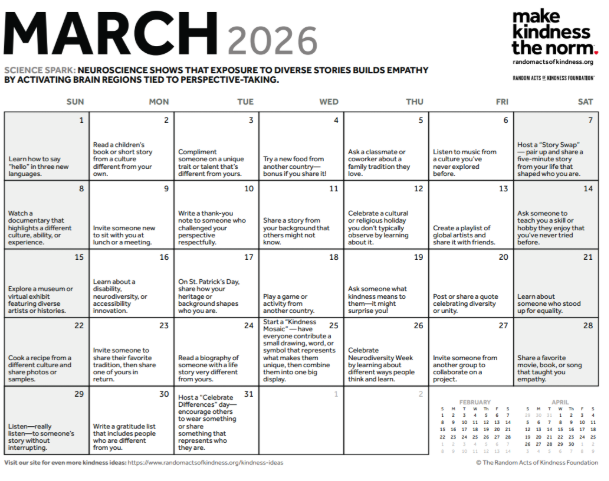
Spreading Kindness Like Confetti ✨
From February 14–20, we celebrate Random Acts of Kindness Week—a reminder that small, simple acts can make a big impact. Whether it’s a kind note, a thoughtful check-in, or a moment of self-compassion, kindness benefits our communities and our own wellbeing. Let’s spread kindness to others—and ourselves—one moment at a time. 💛
This year, we celebrate Random Acts of Kindness Week from February 14-20th. Led by the Random Acts of Kindness Foundation, this week is dedicated to highlighting the powerful impact that small, simple acts of kindness can have.
We all know how good it feels when someone does something kind for us, such as offering help with a chore or offering a thoughtful compliment. But did you know that when we are the ones offering kindness, our brains get a boost of feel-good chemicals and we feel more connected to the people around us? Random acts of kindness benefit both our communities, and ourselves!
Here are some ways that you can practice random acts of kindness:
Leave a positive note for a friend, co-worker, or family member to find
Donate clothes or household items that you no longer need
Listen to someone who needs to vent
Bake a treat for a friend, family member, or neighbour
Compliment someone's hard work
Call or text an old friend to check in
Send or repost a funny meme
Collect garbage that you see on the ground while you're out and about
Hold the door open for someone
As we focus on spreading kindness to others, it's also important to remember yourself. Showing compassion to yourself can reduce stress, build resilience, and support overall wellbeing. And remember, self kindness can look different for everyone, there is no “right” way to do it.
Here are a few ways to practice kindness towards yourself:
Make your favourite meal
List all of the things you love about yourself
Allow yourself to take a deep breath and reset
Put down your devices and do something creative
Use positive affirmations
The Random Acts of Kindness Foundation website has monthly kindness calendars to make spreading kindness even easier!

Life Skills Needed for the Holidays (and Tips to Prepare for a Busy Holiday Month)
The holiday season can be exciting—but for many neurodivergent people, it can also bring extra stress. Changes in routine, busy schedules, sensory overload, and social expectations can make this time of year feel overwhelming. Building a few key life skills can help you move through the season with more comfort and confidence.
From planning and time management, to emotional regulation, communication skills, sensory tools, and self-care strategies, small supports can make a big difference. Creating visual schedules, preparing calming tools, setting boundaries, organizing tasks, and protecting rest time all help reduce holiday stress.
With the right strategies and understanding of your needs, the holidays can feel more manageable—and even enjoyable. It’s okay to simplify, set limits, and celebrate in ways that work best for you.
For neurodivergent folks the holiday season can be fun, but it can also be overwhelming—extra social events, changes in routine, travel, sensory overload, and pressure to “be on.” Building a few key life skills can help you move through the season with more confidence, comfort, and control.
1. Planning & Time Management
Why it matters:
Schedules can fill up fast—family gatherings, school or work deadlines, shopping, and errands. Without a plan, everything can pile up and cause stress.
Helpful skills:
Using a calendar or visual schedule system
Setting reminders for tasks, events, and downtime
Breaking big tasks (like shopping or preparing for guests) into small steps
Tips:
Choose one place to keep all your holiday plans—digital or paper, whichever works best for your brain.
Build in “transition time” between events so you can decompress.
Colour-code tasks (ex: red for social events, blue for work/school deadlines, green for self-care).
2. Emotional Regulation
Why it matters:
Crowds, noise, unexpected changes, and social expectations can drain energy quickly. Having tools ready makes it easier to stay grounded.
Helpful skills:
Identifying early signs of overwhelm
Having a “calm-down kit” (noise-canceling headphones, fidgets, sunglasses, etc.)
Practicing self-advocacy and setting boundaries
Tips:
Plan and rehearse scripts like:
“I’m going to step outside for a few minutes.”
“I’m not able to stay long, but I’m happy to stop by.”Schedule rest days after big or socially demanding events.
Permission to leave early is self-care—not rudeness.
3. Social & Communication Skills
Why it matters:
Holidays often include group interactions, conversations, and changes in routines. Having communication tools reduces anxiety.
Helpful skills:
Preparing conversation starters
Being honest about personal needs (“I need a quiet space” or “Can we text instead?”)
Understanding social expectations while honoring your comfort level
Tips:
Make a “social energy budget”—decide how many events you can realistically handle.
Use text or email to communicate boundaries if face-to-face feels too hard.
Plan exits ahead of time (e.g., driving separately, safe rides, or scheduling a check-in call)
4. Sensory Awareness & Coping Strategies
Why it matters:
Holiday environments can be loud, bright, crowded, and full of new smells—often overwhelming for sensory-sensitive people.
Helpful skills:
Identifying sensory triggers
Preparing accommodations
Creating sensory-safe routines
Tips:
Bring your own comfort items: headphones, sunglasses, chewy or crunchy snacks, stim toys.
If hosting, adjust lighting, music, or seating to suit your sensory needs.
At gatherings, locate the quietest spot early in case you need a break.
5. Executive Functioning & Organization
Why it matters:
Shopping, budgeting, gift-wrapping, meal planning—holidays come with a lot of moving pieces. EF supports help keep things manageable.
Helpful skills:
Using checklists and step-by-step plans
Setting spending limits
Preparing tasks in small chunks instead of all at once
Tips:
Try a simple checklist like: gifts, food, travel, outfits, accommodations, schedule.
Automate what you can: delivery, pre-made meals, digital cards, etc.
Keep a “holiday bin” so wrapping supplies, tape, and cards stay in one place.
6. Self-Care & Rest
Why it matters:
The holidays are not a marathon you must push through—they’re a time that can be joyful only if your needs are respected.
Helpful skills:
Recognizing burnout
Prioritizing your needs over others’ expectations
Understanding how your body and brain recover best
Tips:
Protect your sleep schedule—even if everything else changes.
Build in “no plans” days to reset.
Choose traditions that make you feel good, not just the ones others expect.
Final Thoughts
Being neurodivergent doesn’t mean the holidays have to be overwhelming. With the right skills and supports, this season can be comfortable, meaningful, and even enjoyable. Preparation and self-understanding are key—plan what you can, protect your energy, create sensory-friendly spaces, and remember that it’s okay to do the holidays your way.

Time Management Finding Balance When Life Gets Busy
Managing time can feel overwhelming, especially during busy or unpredictable seasons. This post shares three practical, neurodiversity-friendly strategies — visual calendars, breaking tasks into steps, and scheduling downtime — to help reduce stress, support executive functioning, and create balance when life gets hectic.
Change, deadlines, and busy schedules can be stressful — especially for neurodivergent people who thrive on structure and predictability. Whether it’s back-to-school season, midterms, assignment crunch time, or the holidays, managing your time in a way that works for your brain can make all the difference.
Here are three practical, flexible strategies to help you manage your time when things start to pile up:
1. Use a Visual Calendar to See What’s Coming Up
Having a visual overview of your week or month can help reduce uncertainty and last-minute stress.
Try using a digital calendar (like Google Calendar) or a paper planner that’s easy to glance at.
Colour-code your activities — for example, blue for school, green for appointments, orange for social plans, and purple for downtime.
Set notifications that remind you in advance — some people like a reminder the day before, and again an hour before.
If visuals help, use stickers or icons to make the calendar feel more engaging and easier to read.
This helps make time visible, which can support executive functioning and planning ahead — especially during busy or unpredictable times.
2. Break Tasks into Smaller Steps and Use Gentle Reminders
Large tasks like “write essay” or “study for exam” can feel overwhelming or hard to start. Breaking them down can make them more manageable and motivating.
Try turning one big task into smaller pieces, like: “choose topic,” “make notes,” “draft intro,” and “edit final version.”
Set reminders for each smaller step instead of just the final due date.
Consider using a reminder app or task manager like Notion, Tiimo, or Todoist — or even sticky notes in a visible place.
Each completed step gives a sense of progress and accomplishment — which can boost motivation and reduce anxiety.
3. Schedule Downtime and Sensory Breaks
Downtime isn’t a reward — it’s a need.
Schedule rest the same way you schedule work or study time. Put it in your calendar or planner so it becomes part of your routine.
Think about what helps you reset — quiet time, movement, sensory breaks, time outdoors, a hobby, or time with trusted people.
Build in “buffer time” between activities so you’re not rushing from one thing to another.
When your schedule includes moments of rest, you’re more likely to sustain focus, energy, and emotional regulation through busy seasons.
Time management doesn’t have to look one way — it’s about finding systems that support your brain and help you feel more in control. With visuals, reminders, and intentional rest built into your schedule, you can reduce stress, prevent burnout, and make room for both productivity and joy.

Aspire Services Featured by the City of Barrie’s Starter Company Plus Program
Aspire Services founder Becky Kurtz was recently featured by the City of Barrie’s Starter Company Plus Program! Learn how her passion for supporting neurodiverse youth and adults grew into a thriving business helping clients build confidence, independence, and real-life skills across Barrie, Simcoe County, and beyond.
We’re proud to share that Aspire Services and our founder, Becky Kurtz, were recently featured by the City of Barrie’s Starter Company Plus Program — highlighting the journey of building Aspire Services from passion into purpose.
Becky completed the Starter Company Plus program five years ago and has continued to grow Aspire Services ever since, guided by the principles, confidence, and strong business network she developed during her time in the program.
Turning Passion Into Purpose
Becky’s passion for supporting neurodiverse youth and adults started early and evolved into a full career path. Her experience across education, intensive behavioural intervention, and applied behaviour analysis helped her understand the unique needs of individuals at different life stages.
After relocating to Barrie, Becky recognized a clear gap — there were very few services available for adolescents and young adults to continue building life skills. Rather than waiting for change, she created it herself.
“People don’t just stop growing at twelve years old,” Becky shared. “There was almost nothing in place to help teens or young adults develop life skills.”
Empowering Neurodiverse Youth and Adults
Aspire Services focuses on life skills coaching and group programs for neurodivergent teens and adults, both in-person and virtually. The goal is simple yet powerful — to help each person become the best version of themselves by building independence, confidence, and real-life tools for success.
“I want to be someone’s cheerleader,” Becky says. “I’m here to support people and teach them the life skills they need.”
Growing a Business in Barrie
Barrie became the natural home for Aspire Services because the community had a real and immediate need. Over the past five years, Aspire has grown from a solo venture into a full team, expanding group programs, adding virtual offerings, and partnering with national initiatives like EmploymentWorks, a federally funded program designed to help neurodivergent individuals prepare for the workforce.
“At the time, it was just me,” Becky reflected. “Now I have a whole team, and that’s helped me serve more people in more ways.”
Community and Continuous Growth
Community has been central to Becky’s success — from the support of the Small Business Centre to the network built through Starter Company Plus. Even during the challenges of COVID, she stayed connected, finding encouragement and mentorship that continues to shape Aspire’s path forward.
“It’s about finding your own cheerleaders and building a strong network,” she said. “That sense of community has stayed with me.”
Looking Ahead
As Aspire Services continues to grow, so does Becky’s vision — helping neurodiverse individuals build skills that open doors to independence, employment, and a fulfilling life.
We’re incredibly proud to be part of Barrie’s thriving small business community and grateful for the programs and people that helped us get here.
👉 Read the full feature article on the City of Barrie’s website